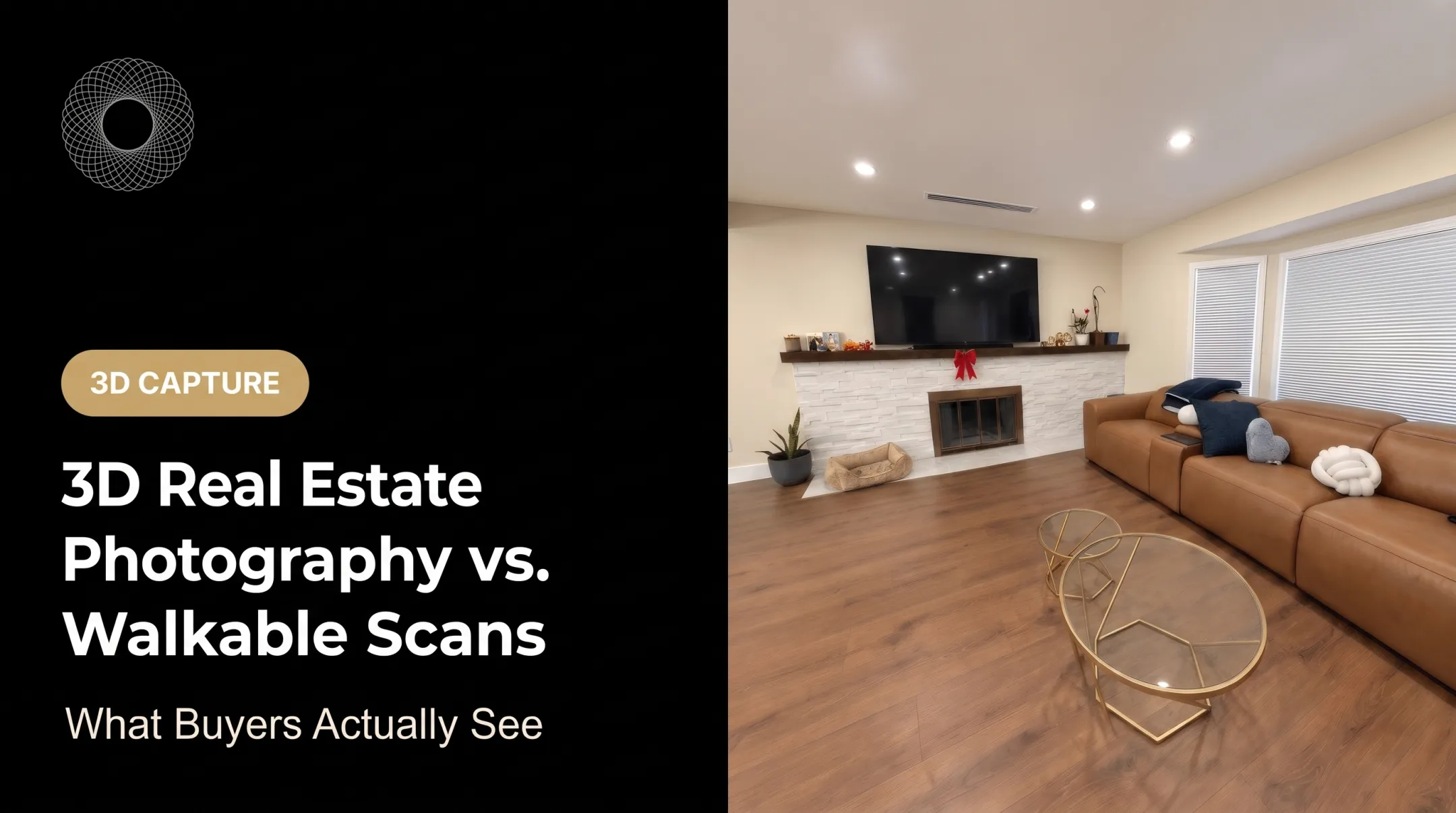
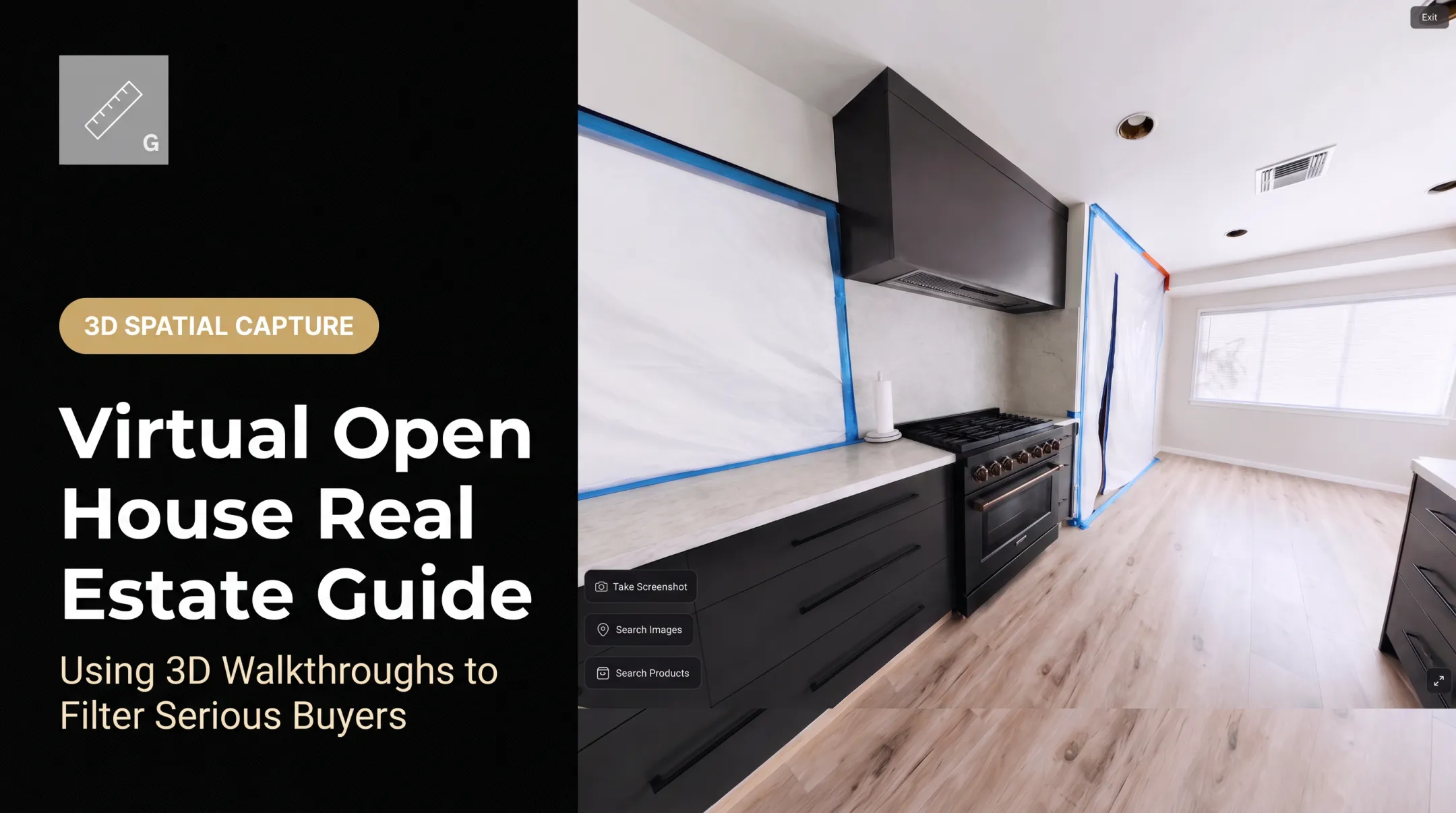
For agents and marketers, that difference shapes how well buyers grasp layout, condition, and scale before they book a showing. Zillow reports that listings with its 3D Home interactive floor plan averaged 43% more page views than comparable listings. That package includes specialized exposure, so it's vendor data, not proof that one format wins.
Below, we compare the two on viewer control, spatial clarity, storytelling, mobile use, production demands, and value for remote buyers.
Key Takeaways
- 360 video gives a guided, spherical view, but viewers follow a timeline or fixed points.
- A walkable 3D scan connects rooms into a model buyers explore at their own pace.
- Video wins on storytelling and quick discovery; scans win on layout, inspection, and remote decisions.
- The right pick depends on the property, the buyer journey, and the channel.
360 Real Estate Videos vs. Walkable 3D Scans: Quick Comparison
| Criterion | 360 video | Walkable 3D scan |
|---|---|---|
| Buyer control | Look around; route is pre-recorded | Choose rooms, direction, and revisits |
| Layout clarity | Broad flow, less precise transitions | Connected rooms, dollhouse or floor-plan views |
| Measurements | Not designed for them | Available on some platforms, with limits |
| Storytelling | Narration, pacing, music | Buyer-led, factual |
| Production | Camera, stitching, editing | Capture, cloud processing, hosting |
Buyer control and navigation
In a 360 video, the viewer controls the gaze but not the path. The camera's recorded route sets the sequence.
Scans let buyers pick a room, turn around, and go back to the kitchen. "Walkable" has a boundary, though. On Matterport, visitors move between captured positions, not anywhere in the space.
Layout and spatial understanding
Video conveys how rooms look and roughly how they connect. Transitions can blur the exact relationship between a hallway and a bedroom.
Scans add dollhouse views and floor plans, which make circulation easier to read. Connected 360 panorama tours sit in between: interactive, but not a measured model.
Detail inspection and measurements
Viewers can pause and zoom in a video, but the footage isn't built for in-space measurements.
Scan platforms often include measurement tools, and accuracy varies by platform and capture method. Vendor-published figures are not independent validation:

- Matterport says active-depth room dimensions are generally within 1% on average, and 360-camera capture within 4-5%.
- iGUIDE calls its viewer measurements approximate estimates.
For furniture fit, that's useful. For a renovation budget, confirm on site.
Emotional presentation and storytelling
Video is the stronger storyteller. You control pacing, add agent commentary, and open on the best view. A scan prioritizes buyer-led discovery over a polished narrative.
Production, access, and cost
Cost comparisons only work for defined services:
- Zillow's panorama tour app and hosting are $0, though equipment and labor aren't.
- Matterport's on-demand capture base fees run $223.75 (0-1,000 sq ft) to $352.82 (2,001-3,000 sq ft), and can vary by up to 30% by location.
- Zillow estimates about 45 minutes to capture a tour plus floor plan. Matterport says a typical 2,000 sq ft home takes roughly 25-38 minutes.
A reliable national price range for spherical-video production is hard to find, so get quotes for your scope.
What Are 360 Real Estate Videos and Walkable 3D Scans?
What is a 360 real estate video?
It's spherical footage from an omnidirectional camera. Viewers look around from the camera's position as it plays or pauses.
Don't confuse it with similar formats:
- 360 video: moving footage along a recorded path.
- Connected 360 panoramas: stills linked so viewers click between points.
- Standard walkthrough video: a flat, fixed-frame recording.
Strengths: guided presentation, atmosphere, and easy use on listing pages and social channels.
Limits: fixed viewpoints, little independent movement, possible stitching artifacts, and clunky mobile interaction.
What is a walkable 3D scan?
It reconstructs the property as an interactive model. Buyers move between viewpoints and inspect the space on their own.
Features to check on any platform:
- Room-to-room navigation
- Dollhouse or floor-plan views
- Measurements and close inspection
- A shareable link
Vroomk is one example. Its 3D Spatial Capture creates a continuous walkthrough of every room and angle, supports measurement, and exports thousands of stills. It opens in a browser through a private link. Measurement accuracy limits are not published, so treat dimensions as guidance until you verify them on site.

Which Gives Buyers a Better View?
"Better" depends on what the buyer needs: a fast impression, a story, a clear layout, or confidence before traveling.
When 360 video fits
- The appeal is atmosphere, design, views, or finishes.
- You need a guided narrative.
- The asset must work in a video-first or social setting.
When a walkable scan fits
- The floor plan is complex.
- Buyers want to compare room sizes or plan furniture.
- Condition matters.
- The buyer will evaluate remotely before visiting.
Relocation, out-of-town, investor, and time-poor buyers benefit most from self-directed scans, since they can revisit areas without another showing. One caution: NAR's 2025 buyer survey found 38% of internet-using buyers rated virtual tours very useful, but it doesn't separate formats or isolate remote buyers.
Video may spark stronger first engagement, while scans give stronger decision support. No current third-party study proves either claim. Harvard research on 75,000 LA-area sales also found no significant sale-price benefit from virtual tours after controlling for listing quality.
The hybrid approach
For high-value or complex listings, lead with edited video or 360 content to draw attention. Then offer a walkable scan to buyers who want to validate layout, condition, and fit.
Real-World Examples/Case Studies
A scan used for documentation after damage
After a ceiling collapse, a homeowner called Vroomk's emergency hotline. The team arrived within a few hours and scanned everything. The private link was ready in two days, and the homeowner sent it to an attorney for insurance and legal coordination.
That is a documentation case, not a listing case. It shows the scan's core strength: a persistent, shareable record that outlasts a site visit. No sales metrics are attached.
Spherical video for a luxury property
Samsung documented a Gear 360 video tour of a $49M property presented to 2,500 Coldwell Banker realtors. The verified result is reach among agents, not buyer conversion. This 2018 vendor case also reports one agent's physical viewing time dropping from four hours to 30 minutes, though it isn't tied to that listing.

Design-led homes like this benefit from video's pacing and narration.
Takeaway
Use video to sell the feeling. Use a scan when you need a measurable, revisitable record. If you need that record, explore how Vroomk supports interactive property documentation.
Conclusion
360 videos are a strong choice for guided storytelling and early discovery. Walkable 3D scans are generally better for independent exploration, layout comprehension, measurements, and serious remote evaluation.
The strongest strategy often uses both at different stages of the buyer journey. Treat the choice as a sequence, not a permanent either-or.
Frequently Asked Questions
What are 360 virtual tours for real estate?
They use spherical images or video so viewers can look around a property remotely. Some link panoramas for room-to-room clicking; others only allow viewing from fixed capture points.
Does YouTube still support 360-degree videos?
Yes. YouTube supports 360 upload and playback in current Chrome, Firefox, Edge, or Opera, and in the YouTube mobile app. Footage must be stitched and encoded at high resolution, and processing can take up to an hour.
What is the difference between a 360 video and a 3D scan?
A 360 video is recorded spherical footage you look around in. A 3D scan is a navigable spatial model that lets buyers move through rooms and may offer measurements or floor plans.
Are 3D scans better than 360 videos for real estate?
Scans usually suit layout, inspection, and remote evaluation better. 360 videos can win on guided storytelling, visual impact, and social discovery.
Can buyers measure rooms in a walkable 3D scan?
Some platforms offer measurement tools or dimension outputs. Accuracy depends on the platform and capture method, so confirm critical dimensions on site.