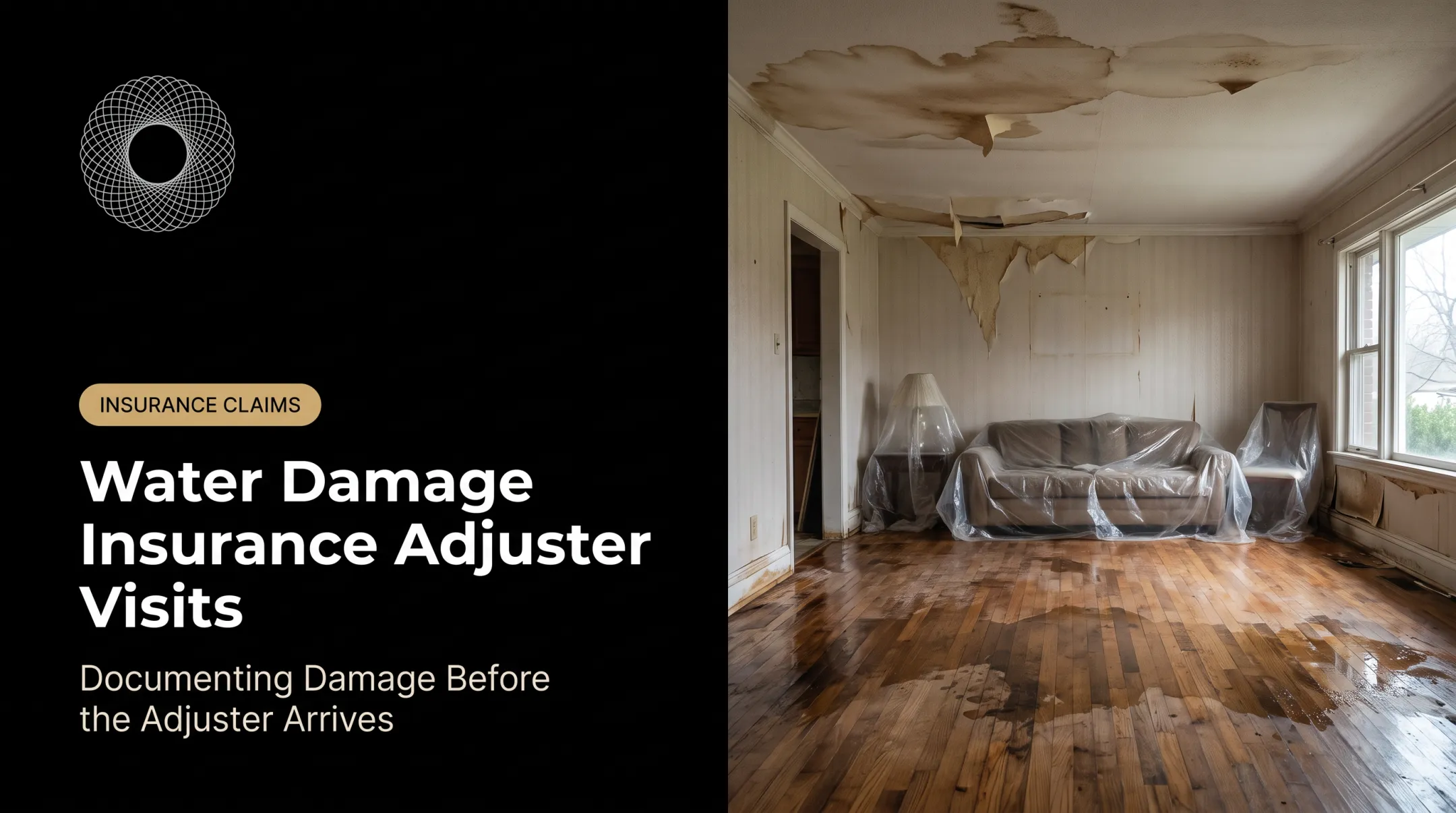
Introduction: Why Documentation Comes Before Mold Remediation
Mold claims usually turn on two questions. What caused the moisture, and what was damaged before cleanup or demolition changed the evidence?
Once drywall is cut out and flooring is hauled away, you can't get that proof back. Insurers decide coverage on cause, so a thin record puts the whole claim at risk.
The rule is simple. Protect people and stop ongoing damage first. Then photograph, record, and preserve the property's condition before permanent remediation, whenever it's safe and practical.
This guide walks through policy review, visual documentation, water-source records, contents inventory, professional reports, and organized communications. It also covers what to do if the claim is denied or underpaid.
Key Takeaways
- Mold isn't automatically covered; the cause of the water usually decides it.
- Record source, timeline, affected areas, and contents without guessing at cause or value.
- Emergency mitigation can't wait, but document conditions and keep every invoice.
- A room-by-room digital record lets every stakeholder review the same property.
What Determines Whether Mold Damage Is Covered?
Homeowners, renters, condo, commercial, and flood policies each treat mold and water damage differently. Read your declarations page, exclusions, conditions, endorsements, and sublimits. Check your state's requirements too, since general rules often don't apply.
| Policy type | How mold is typically treated |
|---|---|
| Homeowners (HO-3) | Often treated as maintenance; III guidance notes remediation may qualify after a covered peril such as a burst pipe |
| Renters (HO-4) | Covers your belongings; sudden burst pipes or overflowing appliances may qualify |
| Condo (HO-6) | Generally excluded unless a covered loss caused it; flood-caused mold excluded |
| Commercial | Standard property forms often exclude fungi or apply steep sublimits |
| NFIP flood | Mold generally excluded |
When Is Mold More Likely to Be Connected to a Covered Loss?
A sudden or accidental event creates the best coverage pathway. Examples include a burst pipe, an appliance failure, or water used to put out a covered fire.
Policies may treat these costs separately:
- Original water damage and resulting mold
- Building repairs and contents
- Temporary living expenses
- Testing and remediation
Tie each expense you claim to specific policy language.
When Is Mold Commonly Excluded or Limited?
Common exclusions include:
- Long-term or repeated seepage
- Deferred maintenance and unresolved roof or plumbing leaks
- High humidity and poor ventilation
- Pre-existing conditions
- External flooding, which needs separate flood coverage
Optional add-ons can change the picture. Water-backup endorsements, hidden-water-damage coverage, and mold endorsements may help. Florida's insurance regulator, for example, lists mold limit increases to $25,000 or $50,000 as options, not typical base limits. Confirm whether any of these appear on your declarations page.
How Much Could a Claim Pay?
No one can responsibly promise a payout. The amount depends on these factors:
- Covered damage: only losses tied to a covered cause
- Deductible: a dollar amount or a percentage
- Sublimits: separate mold caps can restrict recovery
- ACV vs. RCV: actual cash value subtracts depreciation; replacement cost doesn't
- Contents: valued on either basis, usually with purchase dates and receipts
- Additional living expenses: qualifying costs above normal spending when a covered loss makes your home unlivable

The initial payment on a replacement-cost policy is often ACV. Recoverable depreciation typically requires proof of completed repairs.
Keep property repair compensation separate from bodily injury or legal damages. Those fall under different coverage, such as liability.
How to Document Water and Mold Damage Before Remediation
Start With Safety
Don't disturb suspected contamination, and restrict access when appropriate. Use qualified professionals for hazardous conditions. The EPA advises against running fans until you know the water is clean, and contaminated-water work calls for professional expertise.
Preventing more damage can take priority over waiting for an inspection. Maryland's insurance regulator says not to wait for the adjuster before making temporary repairs.
Record the Source and Timeline
Write down while it's fresh:
- When you noticed the leak, overflow, or storm intrusion
- What you did to stop it
- When mold first appeared
- Who you contacted, and when
The EPA's 24 to 48 hour drying window applies to clean-water damage. It isn't a guaranteed threshold, and mold can appear within it.
Capture Photos and Video
Per FEMA guidance, take photos and video before cleaning, repairing, or discarding anything.
Start wide, then move in close:
- Exterior, entry points, and affected rooms
- Ceilings, walls, floors, cabinets, and HVAC areas
- Nearby unaffected areas for comparison
- Staining, swelling, peeling, discoloration, and visible growth
- Standing water and waterlines
Note the room, surface, direction, approximate dimensions, and distance to the suspected source on each shot. Keep original files and don't edit away dates or location data.

Inventory Contents and Building Components
List damaged contents and building components separately. For each item, record:
- Description, quantity, and location
- Condition and ownership
- Receipts or proof of value
- Whether it was moved, dried, discarded, or kept
Photograph What's About to Change
Before cutting drywall, pulling flooring, discarding contents, or applying antimicrobial treatments, photograph the condition when it's safe.
Keep removed materials or samples only when appropriate, and ask your insurer or a qualified professional about testing and storage. Hazardous flooded contents may need immediate disposal after photos.
Use a Room-by-Room Spatial Record
An interactive 3D walkthrough preserves one continuous reference to pre-remediation conditions. Reviewers can revisit rooms remotely, take measurements, and export images without repeated property visits.
Vroomk offers this kind of capture, with shareable links, measurements, and thousands of exportable stills. One homeowner reported that Vroomk arrived within a few hours after a ceiling collapse and scanned everything before the insurer removed the damaged materials.
It's a coordination tool for owners, restoration teams, adjusters, inspectors, and attorneys. It supplements policy review, professional inspection, lab testing, and legal advice. It doesn't replace them.
How to Build a Claim-Ready Evidence File
Organize everything into one file:
- Master chronology. Separate observed facts from assumptions. Include discovery date, emergency actions, inspections, drying, testing, removal, repairs, and insurer contacts.
- Policy materials. Declarations page, full policy wording, endorsements, exclusions, limits, deductible, notice provisions, and proof-of-loss requirements.
- Professional records. Plumber or leak-detection findings, moisture readings, drying logs, hygienist reports, lab results, remediation protocols, estimates, invoices, and permits. Note who prepared each and what question it answers.
- Valuation file. Photos, receipts, bank or card records, warranties, and written estimates. Label estimates and uncertainty rather than guessing or exaggerating.
- Communication log. Every call, email, appointment, request, authorization, and delay. The NAIC suggests logging the person, date, time, discussion, and next steps.

Proof-of-loss deadlines vary. North Dakota's regulator cites 60 days after an insurer's request, while the NFIP's 2025 manual cites 60 days from the loss. Check your own policy.
Once the file is complete, control how you share it. Use secure links or access-controlled folders when several parties need the same evidence. NIST digital evidence guidance recommends keeping originals separate from working copies.
Coordinating Emergency Mitigation, Inspection, and Remediation
Report the loss promptly. Ask what inspections, testing, emergency services, documentation, and authorizations the insurer requires. Confirm verbal instructions in writing.
Separate temporary mitigation from permanent work:
- Temporary: stopping a leak, extracting water, drying, protecting property
- Permanent: demolition, replacement, final mold treatment
Get written approval for permanent work when feasible, without delaying safety measures.
Tell the adjuster, restoration contractor, inspector, industrial hygienist, owner, and any legal representatives what was documented before alteration and which materials remain available. A shared walkthrough link helps here, since everyone sees the same rooms.
After remediation, keep the pre-remediation record alongside:
- Drying logs
- Clearance documentation
- Invoices and warranties
- After-photos
No federal agency sets mold or spore threshold limits, so clearance typically relies on a qualified professional's verification.
What to Do If the Claim Is Denied or Underpaid
- Ask for the written position. Request the policy language relied on, the factual basis, the amount allowed, and any missing documents. California's insurance department requires written denials to state factual and legal bases.
- Compare it to your file. Check the chronology, water-source evidence, photos, spatial record, reports, invoices, and endorsements. Then send a focused appeal answering each disputed point, not a pile of unsorted files.
- Learn your deadlines. Research state complaint procedures, appraisal provisions, public-adjuster rules, and suit limitations. California's statutory fire-policy wording, for instance, sets 12 months, but that isn't universal. Appraisal typically decides cost, not coverage.
- Get advice before you sign anything. Talk to a professional before signing a release, giving a sworn statement, or letting a contractual deadline pass.

Mold disputes can involve coverage, causation, valuation, workmanship, health, and liability. Depending on the issue, an environmental consultant, licensed public adjuster, or policyholder attorney may fit. A shared spatial record lets them open one scene, pull measurements, and export stills.
Frequently Asked Questions
How much compensation can you get for mold?
It depends on the covered cause, policy limits and mold sublimits, deductible, valuation method, documented damage, mitigation costs, and any additional living expense coverage. Amounts vary widely by claim.
Why is mold not covered by insurance?
Policies often exclude gradual moisture, maintenance failures, humidity, pre-existing conditions, and external flooding. Some cover mold that results from a covered sudden water event or an endorsement.
What should you document before mold remediation?
Capture the full condition set before work begins:
- Water source and timeline
- Room-by-room photos and video
- Visible damage and affected contents
- Removed materials and professional reports
- Receipts and claim communications
Should you remove mold before filing an insurance claim?
Don't delay safety or emergency mitigation. When practical, document conditions first, notify your insurer promptly, and avoid unnecessary permanent repairs or disposal.
Does homeowners insurance cover water damage that causes mold?
It depends on whether a covered peril caused the water damage. Insurers often review the water damage, resulting mold, exclusions, deductibles, and limits as separate issues.