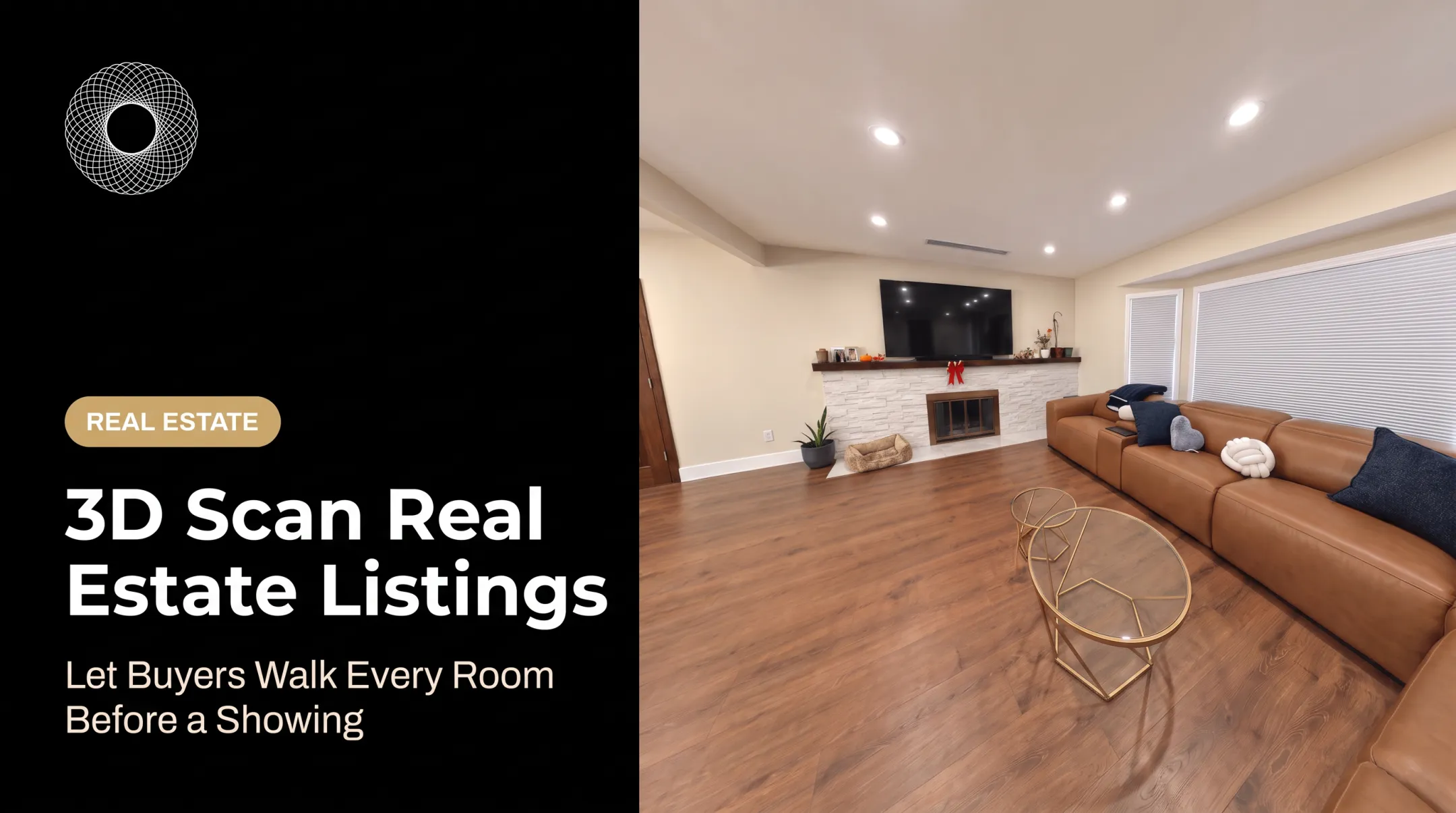
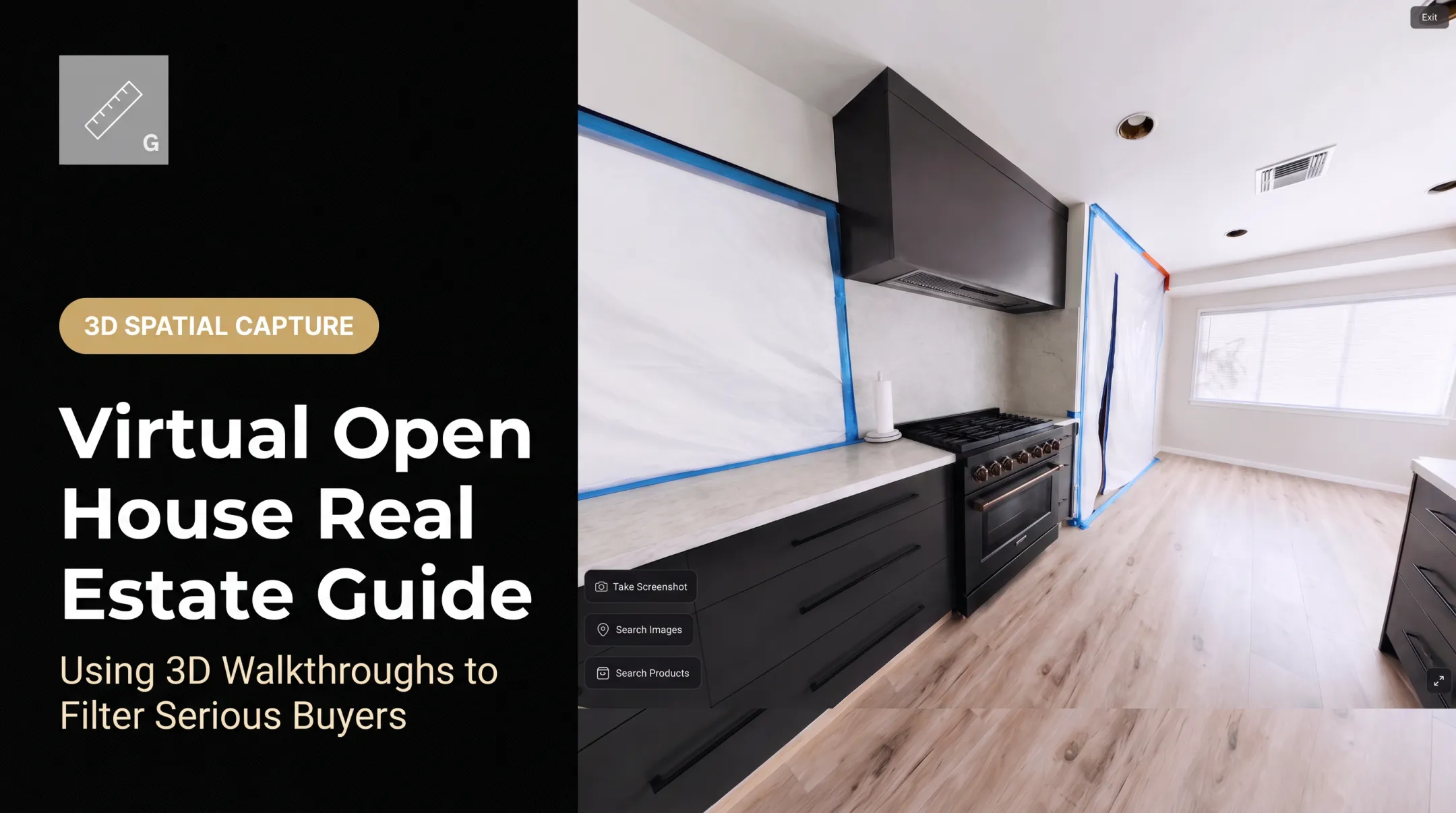
The mix-up has consequences. A photo gallery makes a fast visual impression. It rarely explains how rooms connect, how far apart they sit, or what the house feels like to walk through. Buyers can arrive at a showing surprised by layout, scale, or condition.
Buyer research shows photos still lead. In NAR's 2025 report, 83% of internet-using buyers rated photos "very useful," versus 57% for floor plans and 41% for virtual tours. This article compares what each format actually delivers.
Key Takeaways
- Photo-led media is curated for visual impact; a walkable scan is built for exploration.
- Rendering creates or alters an image; a scan documents an existing space.
- Scans matter most when layout, room flow, or remote review is the question.
- Photos attract attention; scans help qualified buyers decide to book a showing.
3D Real Estate Photography vs. Walkable Scans: Quick Comparison
| Dimension | Photo-led "3D" media | Walkable scan |
|---|---|---|
| What the buyer sees | Curated stills, panoramas, or renderings chosen to show finishes, light, and standout features | A connected environment where the viewer moves between captured positions |
| Spatial context | Selected angles; may not show how rooms connect or what lies outside the frame | Entrances, hallways, stairs, and transitions, where captured |
| Accuracy | Composition comes first; wide-angle lenses, editing, and rendering shape perception | Spatial context, plus measurements or floor plans on some platforms; not a certified survey |
| Best role | Galleries, thumbnails, brochures, social posts | Remote buyers, complex homes, pre-showing research |
| Cost and reuse | Photographer time, editing, rendering, revisions, licensing | Capture complexity, processing, hosting, privacy review, exports, link longevity |

Accuracy and interpretation
NAR warns that wide-angle lenses, especially in small rooms, can distort proportions and disappoint buyers who later see the real space. Apparent size in a photo is not dimensional evidence.
Scans carry their own caveats. Vendor accuracy figures come from controlled conditions, not finished models. Treat any measurement as an estimate unless a professional verifies it.
Cost
Published prices vary widely. HomeJab, for example, lists 15 professional photos from $179 and an interactive 3D tour from $319 for homes up to 4,000 sq ft. Those are one provider's starting prices, not national averages.
Vroomk lists spatial capture from $1.50 per square foot. Compare what each quote includes: hosting, exports, revisions, and how long the link stays live.
What 3D Real Estate Photography and Walkable Scans Actually Show
What is 3D real estate photography?
3D real estate photography is an umbrella label covering professional stills, 360 panoramas, interactive tours, or computer-generated renderings. This article narrows the comparison to photo-led media versus a navigable spatial scan.
In a photo-led experience, buyers see chosen compositions, corrected lighting, material details, and room highlights. Sometimes they get a fixed 360 viewpoint. They don't get continuous movement or reliable measurement.
It belongs at the top of the buyer journey:
- MLS and listing-page galleries
- Search-result thumbnails
- Social posts and brochures
- Early shortlist decisions on whether a home deserves a closer look
What is a walkable scan?
A walkable scan connects multiple captured viewpoints into one interactive space. Depending on the device and platform, it can also produce a floor plan, measurements, and exported stills. Vroomk's captures, for instance, document every room and angle as one continuous walkthrough in the browser.
A buyer typically:
- Opens a shared link.
- Picks a floor or room.
- Moves through doorways and corridors.
- Looks around from each capture point.
- Uses labels, floor plans, or measurement tools if available.

The limits are real. The viewer sees only what was captured. Navigation can have gaps, and lighting or stitching can affect perception.
Matterport's own documentation describes black holes in a model where scan data overlaps too little. A scan does not replace a showing, inspection, appraisal, survey, or legal verification.
Use Cases of Both Formats
Property type changes the answer.
- Simple apartments: strong photos plus a clear floor plan often suffice.
- Multi-level homes: a scan lets buyers move floor to floor.
- Luxury and commercial spaces: both formats help; photos sell the appeal, scans show scale and flow.
- Remote or relocating buyers: scans let them review repeatedly and plan targeted visits.
Scans also support work beyond marketing. Contractors, insurers, and restoration firms use them to preserve a shareable record of completed spaces or existing conditions. Vroomk supports this kind of documentation.
Still, a record of conditions is not an inspection. A buyer cannot conclude from a scan that a home is free of defects.
3D Real Estate Photography vs. Walkable Scans: Which Is Better?
Neither wins universally. Weigh these factors:
- Property complexity and layout
- Where the buyer lives
- Required listing assets
- Level of spatial detail needed
- Privacy, hosting, and reuse
- Turnaround and total cost
Choose photo-led media when you need
- A fast first impression
- Highlighted architecture or finishes
- Images for listing platforms and social campaigns
- A tightly controlled visual story
Choose a walkable scan when you need
- Clear room-to-room flow
- Support for remote or relocation buyers
- A clear read on a complex layout
- Fewer avoidable preliminary showings
- A private, shareable spatial record for authorized people
Use both
When a listing needs attention and orientation, combine them. Photos drive discovery; the scan supports deeper evaluation. A floor plan or short video can fill remaining gaps, but the formats aren't interchangeable.
Zillow's data illustrates the engagement side. Its 3D Home FAQ reports 43% more page views and 49% more saves on average for listings with tours, interactive floor plans, and added exposure. That's a platform claim for a bundle, not an isolated scan effect.

A Harvard Business School working paper on 75,178 Los Angeles-area sales found no significant sale-price lift after controlling for photo quality.
Where Vroomk fits
Vroomk fits teams that need interactive 3D documentation: continuous walkthroughs, measurement tools, exported stills, and private shareable links. It does not offer standalone photography. Confirm current deliverables and scope before booking.
Decision checklist
- Must the media show appearance, layout, condition history, or measurements?
- Who will view it?
- Where will it be hosted?
- How will privacy be handled?
- How long must it stay accessible?
Real-World Examples and Case Studies
Clean, independently verified case studies are scarce in this category. These examples show what photos and walkable scans can deliver, and where the claims stop short.
Photos-led example. Modern Angles reported that a dated Armonk, NY home sold in 3 days at 10% over asking after professional photography. The source doesn't establish that photos were the only media, so it isn't a clean photos-only comparison. It does show photos can drive competitive interest.
Walkable scan example. Matterport's customer account describes BHHS Professional Realty in Ohio, where an international buyer viewed a Matterport tour of a luxury home after 4 days on market and offered without visiting. This is a vendor-published account, not an audited result.

Vroomk. Its Condition Preservation service sends serious buyers one link to walk every room before booking. One testimonial says serious buyers still come, tire-kickers usually don't, and showings run shorter and more intentional. That account does not publish conversion, price, or time-on-market metrics.
Practical recommendation (not a sourced result): pair standard listing photos with an interactive 3D record. Photos earn the click; the scan answers layout questions before anyone drives over.
If you need a private, shareable walkthrough or detailed spatial record, review Vroomk's interactive 3D documentation and ask about available workflows.
Conclusion
Photo-led media is usually stronger for presentation and first impressions. Walkable scans are stronger for layout, flow, and remote exploration.
The right choice depends on what your buyers will ask and how complex the property is. When a listing must communicate both appearance and spatial relationships, use both.
Frequently Asked Questions
What is 3D photography?
A broad term that can mean 360 images, interactive tours, spatial captures, or rendered visuals. Confirm exactly which deliverable you're buying.
What is 3D rendering in real estate?
Rendering generates an image from a 3D model, often for an unbuilt, redesigned, or virtually staged space. It differs from capturing an existing property.
Does Zillow allow virtual tours?
Yes. Zillow accepts many third-party tour providers through MLS links, but states it does not show Matterport tours. Rules change, so check current guidance.
What is the difference between a 3D real estate tour and a walkable scan?
"3D tour" is a broad presentation term. A walkable scan specifically means connected viewpoints the viewer navigates through a captured space.
Can a walkable scan replace listing photos?
Usually not. Scans add layout context, but thumbnails, galleries, brochures, and social posts still need curated images.
Are walkable scans accurate enough to measure a property?
Some platforms offer measurement tools or floor plans, but accuracy depends on the capture system and workflow. Verify dimensions independently; a scan is not a certified survey or inspection.